[Bangla Software] Books By Shaykh Ibn al-Uthaymeen

Shaykh Muhammad bin Salih al-Uthaymeen

Shaykh Muhammad bin Salih al-Uthaymeen

book of Hajj & Umrah by Shaykh Muhammad bin Salih al-Uthaymeen

The Veil, Bengali / Bangla Book by Shaykh Muhammad bin Salih al-Uthaymeen

Bengali / Bangla Book by Shaykh Muhammad bin Salih al-Uthaymeen

Bengali / Bangla Book by Shaykh Muhammad bin Salih al-Uthaymeen

Shaykh Muhammad bin Salih al-Uthaymeen

Shaykh Muhammad bin Salih al-Uthaymeen

Shaykh Muhammad bin Salih al-Uthaymeen

www.ibnothaimeen.com

Attending A Christian Wedding

Question: My mother, who is a Christian, is getting married soon inshaa’ Allaah and the marriage will take place in a church. She wants me and my wife to attend, what is your advice to me?

Answer: With regards to this question Shaykh Wasiullaah al-Abbas Says: In reality even though there are times when you have to look at the benefit that issues like this may bring, there is no doubt that there is much shirk in the church where the marriage is going to take place as the priest may mention matters of shirk etc. Therefore, it is not permissible to be there or to attend churches, as Allaah says {then after the remembrance, sit not you in the company of those people who are the Zaalimoon (polytheists and wrong doers).} [al-An`aam 6:68] We advise the brother with giving his mother her rights regarding kindness, and as such he should excuse himself in a good manner, from attending. Perhaps he may give her an appropriate gift so that she will Maintain good relations with him. However, it is not permissible to Attend the church due to the shirk that occurs within.

WAL-HAMDU LILLAAH.
FIKS Research Department www.TheFiks.org

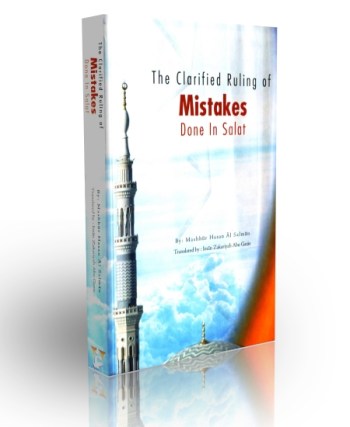
The Clarified Ruling of Mistakes done in Salat

The Clarified Ruling of Mistakes done in Salat by Shaykh Mashur Salman

Download

(Right click then save target as)

To Every Muslim
Who is keen to perform
The most important article
of Islam sincerely and properly in
Accordance with the Prophets (صلى الله عليه وسلم)
sunnah and hence gaining
the best rewards from
his Rabb (Lord)

by Shaykh Mashhur Hasan al-Salman (حفظه الله)
Translated by: Imān Zakariyah Abu Gazie

This book “The clarifying Discussion of Mistakes Done in
Salāt” discusses many mistakes that are commonly committed by
praying Muslims. The authenticity of some of which is not
established; on the contrary they are mere innovations. And others
are some optional or obligatory acts that are not done in their
proper positions or in the appropriate manner. No doubt that
plotting away false beliefs and misconceptions from peoples’ minds
and hearts by establishing truth instead, is on of the greatest paths
of calling to that which is one good [i.e. calling to Allāh aza wa jal]..

Fataawaa of Shaikh Al-Albaanee

Fataawaa of Shaikh Al-Albaanee

Fataawaa of Shaikh Al-Albaanee

Download

(Right click then save target as)

From Al-Asaalah Magazine
Issues 1-21
Translated and Arranged by: Isma’eel Alarcon
Proofread and Verified by: Muhammad Zorkane
Cover Design by: ‘Adil Ibn ‘Arif

This book is a compilation of all the fataawaa (religious verdicts) given by the late Imaam, Muhammad Naasir-ud-Deen Al-Albaanee, rahimahullaah, in Al-Asaalah Magazine (Issues 1-21), with the exception of two short fataawaa that were excluded. Al-Asaalah Magazine is an Arabic publication that was started in Jordan by several of Imaam Al-Albaanee’s students in the early 1990’s in order to promote the Salafi Da’wah and connect the Muslim world to the major scholars and their students.

Celebrating Valentine’s Day


Download
(Right click then save target as)

In recent years, a new phenomenon has spread among the Muslim
youth – males and females alike – which does not bode well. This is manifested in their imitation of the Christians in their celebration of the Valentine’s Day, which has led the scholars and daa‘iyahs to explain the rulings of sharee‘ah concerning that, out of sincerity towards Allaah, His Messenger, the leaders of the Muslims and their common folk, so that Muslims may have a clear understanding of this issue and so that they will not fall into that which will undermine the belief (‘aqeedah) with which Allaah has blessed them.

This is a brief discussion of the origins, development and purpose of this holiday, and what the Muslim should do with regard to it..

Tafsir of Surah al Qari’ah – The Crashing Blow (Surah 101)

by Shaykh ‘Abdur-Rahman ibn Nasir as-Sa’di
Translated by Abu Rumaysah

1) The Crashing Blow!
2) What is the Crashing Blow?
3) What will make you realise what the Crashing Blow is?
4) A day when mankind will be like scattered moths,
5) and the mountains like tufts of wool.
6) Then, as for him whose scales are heavy;
7) he will have a most pleasant life.
8 ) But as for him whose scales are light,
9) a Bottomless Pit will be his matron.
10) What will make you realise what it is?
11) A raging Fire!

“The Crashing Blow” one of the names given to the Day of Judgment, it is called so because its horrors strike man with fear and trepidation. It is for this reason that Allah stressed its gravity and severity by asking, “What is the Crashing Blow? What will make you realise what the Crashing Blow is? “A day when mankind” in abject terror and horror “will be like scattered moths,” like scattered locusts, randomly surging into each other, not knowing where they are going; then, when a fire is lit, they rush headlong into it, unable to perceive its danger. On that Day, despite man being a rational creature, this will be his state.[1] “And the mountains,” firm, mighty, unmoving, “like tufts of wool,” feeble and of such weight that the least gust of wind cause them to flutter away. Allah says, “And you see the mountains that you deem solid flying with the flight of clouds.”[2] Then, the mountains shall become like “scattered dust”[3] and no perceivable trace of them shall remain. Then, the Scale will be erected and man shall be divided into two categories: the felicitous and the wretched. “Then, as for him whose scales are heavy,” i.e. his good deeds outweigh his bad “he will have a most pleasant life,” in the Gardens of Bliss. “But as for him whose scales are light,” whose good deeds do not compare to his bad “a Bottomless Pit,” al-Hawiyah (one of the names of Hell) “will be his matron,” his abode and final destination. It will like a mother to him who always sticks close to him just as Allah says, “surely the punishment thereof is lasting and clinging.”[4] It is also said that the meaning is that his mind will be hurled into Hellfire, meaning that he will be thrown into Hell headfirst. “What will make you realise what it is?” asked by way of emphasising its severity, then the answer is given: “a raging Fire” intensely hot, seventy times hotter than the fire of this world, we seek Allah’s protection from it!

http://www.Islaam.net
————————————————————–

Footnotes
1. Muslim records on the authority of Jabir that the Messenger of Allah (SAW) said,

“My example and your example is that of a person who lit a fire and insects and moths began to fall in it, and he did his utmost to prevent them from falling in. I am grabbing onto your lower garments trying to hold you back from the Fire, but you are slipping from my hand.”

In another place Allah describes the state of man with the words, “With downcast eyes, they come forth from the graves as they were scattered locusts.” [al-Qamar (54): 7]

2. al-Naml (27): 88
3. al-Waqi`ah (56): 6
4. al-Furqan (25): 65

What Is Salafiyyah?

Shaykh Muhammad Saalih Ibn al-Uthaymeen (rahimahullaah)
Source: Liqaa-al-Baab al-Maftooh, #1322
http://www.theclearpath.com

Question: What Is Salafiyyah?

Answer: Salafiyyah is following the way of the Prophet (sal-Allaahu ‘alayhe wa sallam) and his Sahabah for they are our Salaf (predecessors) who preceded us, so following them is Salafiyyah. As for taking Salafiyyah as a special Manhaj (Methodology) such that everyone who differs with it is considered astray even if he was on the truth; then this is beyond doubt opposite to Salafiyyah.

All the Salaf called to Islaam and to unite upon the Sunnah of Allaah’s Messenger (sal-Allaahu ‘alayhe wa sallam) and they did not declare astray anyone who differs with them (in a certain issue) because of (a different) interpretation (Taweel), except in matters of Aqeedah (beliefs) because they considered him, who differed in Aqeedah as astray.

But, in our time, some who took the path of Salafiyyah consider astray everyone who differs from them even if the truth were to be on his side. And they took a Hizbi (partisan) Manhaj, just like the other Hizbs (parties), who divide the religion. This (their way) must be rejected and not be approved of.

It is said, ‘Look at the way of the Salaf as-Salih and what did they do in regards to differences and wideness of their hearts with regards to Ikhtilaaf (differences) in matters in which Ijtihad was feasible. (They differed with each other) to the degree that they differed in big issues, in (minor) issues of Aqeedah and (minor) issues of knowledge – for example, some of them denied that Allaah’s Messenger (sal-Allaahu ‘alayhe wa sallam) saw His Lord and some of them confirmed of it. Some of them said, ‘the deeds would be weighted on the Day of Judgment’, whilst others held that ‘the books which record the deeds will be weighed.’ They also differ in matters of Fiqh, Marriage, obligations, buying and selling, etc. Despite this, they did not declare each other astray.

Thus, Salafiyyah that is taken to mean a special party (Hizb) with specific rules whose members consider anyone who differs with them as astray then they have nothing to do with Salafiyyah.

But the Salafiyyah that is to follow the Salaf in beliefs, sayings, actions, their way of differing and unity, their way of being merciful and compassion to one another as the Prophet (sal-Allaahu ‘alayhe wa sallam) said,

“You see the believers as regards their being merciful among themselves and showing love among themselves and being kind, resembling one body, so that, if any part of the body is not well then the whole body shares the sleeplessness (insomnia) and fever with it.” [1]

Then this is the true Salafiyyah.

——————————————————————————–

Footnotes
[1] Aqeedah: The principles and specific details of belief that one holds in his heart. (ex. Tawheed, Eemaan). Imaam al-Asbahaanee (d.535H) – rahimahullaah – said:

“The sign of Ahlus-Sunnah is that they follow the Salafus-Saalih and abandon all that is innovated and newly introduced into the Deen.” [Al-Hujjah fee Bayaanil Mahajjah 1/364]

Shaykh-ul-Islaam Ibn Taymeeyah – rahimahullaah – said:

“It is not for anyone to place for the ummah a person calling to his path showing loyalty or enmity because of that path other than the Messenger of Allaah (sal-Allaahu ‘alayhe wa sallam).

And it is not permissible to place for them speech, show loyalty or enmity because of it other than the speech of Allaah and His messenger (sal-Allaahu ‘alayhe wa sallam) and that which The Ummah has united upon.

Rather, this is what the people of innovation do who place for themselves a person or some speech and they divide with it the ummah, showing loyalty or enmity upon that person or that kalaam or that attribute. [Majmoo’ al-Fataawa vol. 20, pp. 124]

Manners of the Callers to Islam – Shaikh ’Abdul-’Azeez ibn Baaz (rahimahullah)

The etiquettes, manners and characteristics necessary for the du’aat (callers to Islaam) has been duly explained by Allah – the Mighty and Majestic – in many aayaat  and in many different places in the Noble Qur’an. And from those necessary etiquettes are:

FIRSTLY: SINCERITY
So it is obligatory upon the daa’ee (caller) to have ikhlaas (sincerity and purity of intentions and actions) for Allah – the Mighty and Majestic – neither desiring to show-off, nor desiring reputation, nor desiring the praises and the accolades of the people. Rather, the daa’ee should only call to Allah seeking the Face of Allah, as He – the One free from all imperfections – says:
“Say: This is my path, I do call to upon knowledge.” [Surah Yusuf (12):108]

And Allah – the Mighty and Majestic – said:
“And who is better in speech than one who calls to Allah.” [Surah Fussilat (41):33]

Thus it is a must to have ikhlaas and to call only to Allah – the Mighty and Majestic – and this is the most important ettiquette and the greatest quality; that you seek from your da’wah (call) the Face of Allah and the Home of the Hereafter.

SECONDLY: KNOWLEDGE
To call the people to upon ’ilm (knowledge), and not ignorance: “Say: This is my path, I do call to Allah upon knowledge.” [Surah Yusuf (12):108]

So knowledge is an essential obligation in calling to Allah. So beware of calling to Allah based upon ignorance, and beware of speaking without due knowledge. Indeed, ignorance destroys, it does not build; and it causes corruption, not reformation and correction. So – O worshipper of Allah – fear Allah and beware of speaking about Allah without due knowledge, and do not call to anything except after knowledge of it and having insight into what Allah and His Messenger (sallAllaahu ’alayhi wa sallam) have said.
So it is upon the student of knowledge and the daa’ee to have knowledge of, and insight into that which they call to, knowing its proofs and evidences.

THIRDLY: MILDNESS AND GENTLENESS
From the akhlaaq that it is necessary to have – O daa’ee – is to be mild and forbearing in your da’wah, and being gentle and patient in it, as were all the Messengers alayhimussalaatu was-salaam. Beware of being hasty, harsh and strict in your da’wah, rather be patient, mild and gentle. In this regard, some of the proofs have already preceeded, such as the saying of Allah – the Mighty and Majestic: “Call to the way of your Lord with wisdom and beautiful admonition, and argue with them in ways that are best.” [Surah Nahl (16):125]

And His – the Most Perfect’s – saying: “And by the Mercy of Allah you were able to deal gently with them. If you had been severe and harsh-hearted they would have broken away from about you.”

What is al-‘Aqeedah al-Tahhaawiyyah? What is it about?

Q) What is al-‘Aqeedah al-Tahhaawiyyah? What is it about?

A) Praise be to Allaah.

al-‘Aqeedah al-Tahhaawiyyah is a book dealing with ‘aqeedah (basic tenets of faith) which was written by Imam al-Tahhaawi and named after him. Discussing this ‘aqeedah means that we must look at it from a number of angles.

Firstly:

The author is the imam, muhaddith and faqeeh Abu Ja’far Ahmad ibn Muhammad ibn Salaamah al-Tahhaawi – who is named after a village in Upper Egypt – he studied with many Shaykhs and learned from them and benefited from them, and he listed their number as three hundred Shaykhs.

He was praised by more than one of the scholars:

Ibn Yoonus said: al-Tahhaawi was trustworthy, sincere, a faqeeh and a man of wisdom, and after him there was no one else like him.

Al-Dhahabi said: the faqeeh, muhaddith, haafiz, one of the prominent scholars, and he was trustworthy, sincere, a faqeeh and a man of wisdom.

Ibn Katheer said: He was one of the trustworthy, sincere and a haafiz.

He wrote books which were well-written, comprehensive and of great value, among which was his great book Ma’aani al-Athaar, which contains research on fiqh accompanied by evidence and discussion of controversial matters, and pointing to which view is more correct. His books also include Mushkil al-Athaar and others.

He died (may Allaah have mercy on him) in 321 AH and was buried in Egypt, in al-Quraafah.

See his biography in Siyar A’laam al-Nubala’ (15/33-37) and al-Bidaayah wa’l-Nihaayah (11/174).

Secondly:

This ‘Aqeedah which was written by al-Tahhaawi mentions a number of the beliefs of the righteous salaf and those who followed them of Ahl al-Sunnah wa’l-Jamaa’ah, which was approved by the imams of the Hanafis – as al-Tahhaawi followed the madhhab of Abu Haneefah. He explained in his introduction his aims in doing that, and said:

“This is an explanation of the ‘aqeedah of Ahl al-Sunnah wa’l-Jamaa’ah according to the view of the fuqaha’ of this madhhab: Abu Haneefah al-Nu’maan ibn Thaabit al-Kufi, Abu Yoosuf Ya’qoob ibn Ibraaheem al-Ansaari, and Abu ‘Abd-Allaah Muhammad ibn al-Hasan al-Shaybaani, may Allaah be pleased with them all, and the beliefs concerning the fundamentals of Islam, on the basis of which they submit to the Lord of the Worlds.” End quote.

Then he mentioned these basic beliefs, and the total number of things he mentioned was 105 things believed by Ahl al-Sunnah wa’l-Jamaa’ah in general.

He started by explaining the Oneness of Allaah, may He be exalted, and said a little about the attributes of His Lordship (sifaat ruboobiyyatihi), such as His being alive and self-sufficient, and His being the Creator and Provider, and he affirmed the attributes of perfection without discussing how or likening Him to any of His creation, because Allaah says (interpretation of the meaning): “There is nothing like Him, and He is the All‑Hearer, the All‑Seer” [al-Shoora 42:11]. Then he followed that with a discussion of the obligation to believe in the Prophethood of Muhammad (peace and blessings of Allaah be upon him) and that he was sent to all people. Then he spoke of the Holy Qur’aan, stating that it is the word of Allaah and not created, and he affirmed that the believers will see Allaah in the Hereafter. Then he mentioned some matters of the unseen in which Ahl al-Sunnah believe, such as the Cistern (al-hawd), intercession, the Throne and the Footstool (al-Kursiy). Then he mentioned the pillars of belief in al-qada’ wa’l-qadar (the Divine will and decree) and what Ahl al-Sunnah wa’l-Jamaa’ah believe about this topic. Then he went on to define faith and its pillars, and explained that faith may increase and decrease, and he explained the view of Ahl al-Sunnah in contrast to the views of the Khawaarij and Murji’ah. He also described what Ahl-al-Sunnah believe with regard to the noble Sahaabah (may Allaah be pleased with them), and that loving them is part of Islam, faith and ihsaan, and that hating them is kufr, hypocrisy and sin. Then he mentioned some of the portents of the Hour and what will happen on the Day of Resurrection, then he ended his essay with an discussion of how this religion is the middle path, between exaggeration and falling short.

Thirdly:

It is a book of ‘aqeedah that is easy to read and clear in meaning. It is comprehensive and brief. It sums up the beliefs of Ahl al-Sunnah wa’l-Jamaa’ah and, for the most part, includes matters on which there is scholarly consensus and agreement.

Many scholars have written commentaries on this ‘Aqeedah and explained its words and meanings. One of the most famous of them is Ibn Abi’l-‘Izz al-Hanafi, who wrote a lengthy commentary on it; among later scholars, Shaykh ‘Abd al-‘Azeez ibn Baaz and Shaykh Muhammad Naasir al-Deen al-Albaani (may Allaah have mercy on them) wrote commentaries on it, as did Shaykh Safar ibn ‘Abd al-Rahman al-Hawaali (may Allaah preserve him). The one who wants to understand more of the meanings of al-Tahhaawiyyah can refer to these commentaries.

Fourthly:

‘Aqeedah al-Tahhaawi discusses matters in brief and general terms, but what made it very famous and popular among the Salafis in particular is the commentary which was written by Shaykh Ibn Abi’l-‘Izz al-Hanafi (may Allaah have mercy on him), which is the most important and most detailed of its commentaries. He based his commentary on the books of Ahl al-Sunnah, especially the books of Shaykh al-Islam Ibn Taymiyah (may Allaah have mercy on him) and his student Ibn al-Qayyim (may Allaah have mercy on him).

Fifthly:

Despite what we have referred to of the good features of this ‘Aqeedah and its commentary by Ibn Abi’l-‘Izz, it also contains a number of issues which were criticized, because they go against what the salaf believed, such as his saying, when defining faith: “Faith is affirming with the tongue and believing in the heart,” because limiting it to that is the view of the Murji’i fuqaha’ who excluded physical actions from the definition of faith. The same applies to what he said after that, “Faith is one and the same, and believers are equal with regard to the foundation of faith.”

It also includes some general phrases that may be understood incorrectly, and are most often used by innovators to mean things that are contrary to the beliefs of the righteous salaf, such as his saying, “exalted be He above limits and boundaries” and “exalted be He above having faculties and parts” and “He is not subject to directions and dimensions which are attributes of created beings.” Such phrases are used by those who misinterpret the attributes of Allaah (al-mu’attilah) to deny what is affirmed in the Book of Allaah and the Sunnah of His Messenger of the sublime attributes of Allaah that befit His perfection, may He be glorified and exalted, such as His Countenance, hands and eyes. They call them faculties and parts, and deny that Allaah possesses them.

Another example is His being above His creation, and His rising above His Throne in His heaven. They call this “directions and location” and deny that it applies to Allaah, may He be exalted.

Because of that, it is important for the seeker of knowledge to pay attention to learning this ‘Aqeedah from a scholar of Ahl al-Sunnah who can explain it, such as Ibn Abi’l-‘Izz among classical scholars and from contemporary scholars who have written brief commentaries on it, as we have referred to above.

There are many audio commentaries on this book, such as the commentary by Shaykh Saalih Aal al-Shaykh, and the commentary by Shaykh Yoosuf al-Ghufays, and others.

Shaykh Safar al-Hawaali (may Allaah preserve him) has commented at length on the commentary of Ibn Abi’l-‘Izz; you may refer to it on his website.

And Allaah knows best.

islamQA.com