Download
(Right click then save target as)
The Divine Pre-Decree & Ordainment Of Allaah
Shaykh Muhammad Ibn Saalih al-Uthaymeen
Download
(Right click then save target as)
The Divine Pre-Decree & Ordainment Of Allaah
Shaykh Muhammad Ibn Saalih al-Uthaymeen
Question: Is that which in present days is known as a “military coup” against the ruler, mentioned in the Religion or is it an innovation?
Answer: There is no basis for these actions in Islaam. And it is in opposition to the Islaamic methodology with regard to establishing the da’wah (Call to Islaam) and creating the right atmosphere
for it. Rather, it is only an innovation introduced by the disbelievers, which has influenced some Muslims. This is what I stated in my notes and explanation to Al-‘Aqeedah At-Tahaawiyyah.
[Al-Asaalah, Issue #10]
Download
(Right click then save target as)
Some people think that writing about this topic is writing about a matter that should remain on the periphery of knowledge. They believe in going over this topic in the quickest of fashions and not giving it too much thought.
They think that the benefits of such a study are very limited, and that being ignorant of this topic is not harmful at all.
However, this is not an irrelevant matter. Humans today spend billions of dollars, with which they could develop countries and end poverty in the farthest reaches of the world, on research to discover whether there is any possibility of life on nearby planets. Scientists spend a great deal of their time and resources on this question. What about living beings that are known to exist right here with us on our earth? They live in our houses and they eat and drink with us. In fact, they affect our thoughts and our hearts and even drive us to destroy our own selves and to spill one another’s blood.
No price can be put on the importance of the texts of the Qur’an and authentic hadeeth that have reached us, giving us knowledge of this matter.
Those texts uncover for us the secrets of these fellow-creatures: the world of the jinn.
Shaikh ‘Abdul-‘Azeez Al-Hada said:
“The Shaikh, the great scholar, the ocean (of knowledge), Muhammad Al-Ameen Ash-Shanqeetee (rahimahullaah) – the one whom no knowledge of the Science of Tafseer and the Arabic Language was comparable to during his lifetime – used to respect Shaikh Al-Albaanee so remarkably to the point that when he would see him passing by, and he was giving his class in the masjid of Madeenah, he would stop his class to stand and give Salaam to him out of respect for him.”
The great scholar, the teacher, Muhibb-ud-Deen Al-Khateeb said:
“And from the callers to the Sunnah who devoted their lives to reviving it was our brother Muhammad Naasir-ud-Deen Nooh Najaatee Al-Albaanee “
The great scholar Muhammad Haamid Al-Fiqee (rahimahullaah) said:
“…the brother, the Salafee, the Scholar, Shaikh Naasir-ud-Deen.”
The former Muftee of the kingdom of Saudi Arabia, Shaikh Muhammad Ibn Ibraheem Aali Shaikh (rahimahullaah) said: “And he is the upholder of the Sunnah, a supporter of the truth and an opposition to the people of falsehood.”
During his lifetime, the father, the Shaikh, ‘Abd-ul-‘Azeez Ibn Baaz (rahimahullaah) said:
“I have not seen anyone under the surface of the sky with more knowledge of the Hadeeth in our current time than the likes of the great scholar, Muhammad Naasir-ud-Deen Al-Albaanee.”
And he ( rahimahullaah) was asked about the hadeeth of the Prophet (صلى الله عليه وسلم) :
“Indeed Allaah raises up from this ummah at the beginning of every century someone who will revive it for them (i.e. a mujaddid).” So he was asked who is the mujaddid of this century? He replied: “Shaikh Muhammad Naasir-ud-Deen Al-Albaanee. He is the mujaddid in my opinion and Allaah knows best.”
Shaikh Muhammad Ibn Saalih Al-‘Uthaimeen (rahimahullaah) said:
“From what I came to know of the Shaikh through my gatherings with him – and they were few – was that he was very serious about acting upon the Sunnah and fighting against the innovations, whether in matters of Belief or in matters of actions. As for through my readings of his written works, then I have come to know that about him, and also that he possesses a vast amount of knowledge of Hadeeth, in terms of reporting them and investigating them. And Allaah has benefited many people through what he has written such as about knowledge, aspects of the Manhaj, and concern for the science of Hadeeth. And this is an enormous result for the Muslims, all praise be to Allaah.”
The great scholar, Shaikh Zaid Ibn Fayaad (rahimahullaah) said about him:
“Indeed, Shaikh Muhammad Naasir-ud-Deen Al-Albaanee is from the most prominent and distinguished personalities of this era. He had great concern for the Hadeeth – its paths of transmission, its reporters and its level of authenticity or weakness. This is an honorable task from the best things on which hours can be spent and efforts can be made. And he was like any other of the scholars – those who are correct in some matters and err in other matters. However, his devotion to this great science (i.e. of Hadeeth) is from that which requires that his prestige be acknowledged and his endeavors in it be appreciated.”
Shaikh Muqbil Ibn Haadee Al-Waadi’ee (rahimahullaah) said:
“Indeed, there cannot be found an equal in terms of the knowledge of hadeeth like that of Shaikh Muhammad Naasir-ud-Deen Al-Albaanee. Allaah has given benefit through his knowledge and his books several times more than what has been accomplished by those zealots for Islaam upon the ignorance of those who organize reformation and revolutionary movements. And that which I sincerely believe in and which I owe my thanks to Allaah for is that the Shaikh Muhammad Naasir-ud- Deen Al-Albaanee is from the mujaddideen (reformers/revivers) whom the Prophet (صلى الله عليه وسلم) spoke the truth of when he said: ’Indeed Allaah raises up from this ummah at the beginning of every century someone who will revive it for them (i.e. a mujaddid).’ Reported by Abu Dawood and authenticated by Al-‘Iraaqee and others.”
(Al-Asaalah Magazine Issue #23, pg. 76-77)
In the Name of Allaah, Most Merciful, Bestower of Mercy. I counsel my wife, my children, my friends, and all my loved ones, when news of my death reaches them, that they – first – supplicate to Allaah to forgive me and have mercy on me, and that they do not wail over me nor cry with a raised voice.
Secondly, I advise them to hasten my burial, and that they do not inform my close relatives or brothers (of my death) except for the amount that is necessary to carry out the preparation of my burial. I ask that they put my neighbor and sincere friend, ‘ Izzat Khidr Abu ‘Abdillah in charge of washing my body, as well as whoever he chooses to assist him in that.
Thirdly, I choose to be buried in the closet area (i.e. graveyard), so that those who carry my body will not be forced to place me in a car, and which will consequently lead the followers of the Janaazah (funeral) procession to drive in their cars. I also ask that my grave be put in an old graveyard, which will most likely not be dug up (anytime in the near future)…(Some parts omitted here)…
And it is upon those who live in the land in which I die, to not inform anyone outside of these lands, such as my children – not to mention other than them – until after I am buried. This is so that the emotions will not overwhelm and cause people to act on them, which will in turn result in the delay of my Janaazah (funeral).
I ask the Guardian (Allaah) that I meet Him, while having my past and future sins forgiven by Him…(Some parts omitted here)…
I bequest my entire library – whether the book is printed, photocopied, in manuscript form, in my handwriting or someone else’s – to the library of the Islaamic University of Madeenah. This is because of the good memories I have of it with regard to Da’wah (Calling) to the Qur’aan and the Sunnah upon the methodology of the Salaf As-Saalih when I was a teacher there.
I hope that Allaah will cause it to be of benefit to the leaders of that university, just as the university students benefited from its owner in those days. And I ask Allaah that He benefit me by them (the
students), through their sincerity and in their Da’wah.
[Allaah says:] “O my Lord! Make me thankful for Your Favor that You bestowed upon me, and upon both my parents, and make me one that does righteous deeds that You love. And correct my offspring for me. Surely I repent to You, and surely I am from amongst the Muslims. “
[Surah Al-Ahqaaf: 15]
Muhammad Naasir-ud-Deen Al-Albaanee
On the 27th day of Jumaadaa Al-Oolaa, 1410 AH
Taken from Shaikh ‘Alee Hasan Al-Halabee’s book “With our Shaikh, the Upholder of the Sunnah and the Religion, Muhammad Naasir-ud-Deen Al-Albaanee” (pages 27-28)

Download
(Right click then save target as)
توحیدِ خالص
الشیخ بدیع الدین شاہ راشدی رحمہ اللہ
The Pure Tawheed
Shaykh Badee’-ud-Deen Shah Rashidee rahimaullaah
Download
(Right click then save target as)
کتبِ اہل کتاب پڑھنے اور نقل کرنے کا حکم
فضیلۃ الشیخ محمد بن صالح العثیمین رحمہ اللہ
فضیلۃ الشیخ مشہور بن حسن آل سلمان حفظہ اللہ
فضیلۃ الشیخ یحیی بن علی الحجوری حفظہ اللہ
Rulings regarding Reading and Narrating from the Books of Jews and Christians by Shaykh Muhammad bin Saalih al-Uthaimeen, Shaykh Mashoor Salmaan and Shaykh Yahyaa al-Hajooree
بسم الله الرحمان الرحيم
السلام عليكم ورحمة الله وبركاته
الحمد الله
Seek Istighfaar For Your Sins And Have Taqwaa
“So be afraid of Allaah; and Allaah teaches you. And Allaah is the All Knower of each and everything.” 2:282
Rasoolullaah said, “By Allaah, I seek forgiveness and I repent to Allaah more than seventy times a day.” He also said, “O people repent! Verily I repent to Allaah one hundred times a day.” Muslim 4/2076
The Prophet also said, “Whoever says, Astaghfirullaahal-ladhee Laa Ilaaha Illaa Huwal Hayyul Qayyoomu wa atoobu ilaihi, Allaah would forgive him even is he was one who fled during the advance of an army.” Meaning: “I seek Allaah’s forgiveness, besides whom none has the right to be worshipped (in truth) except HE, The Ever Living, The Self Subsisting and Supporter of all, and I turn to HIM in repentance.” At Tirmidhee 5/569 Al Haakim authenticated it, Imaam Adh Dhahabee agreed.
Have Sincere Intentions
Sufyaan Ath-Thawree , said,“We do not know of anything better than seeking knowledge with (a sincere) intention (for the sake of Allaah).” Siyar A’laam an-Nubalaa. – Vol. 7, Pg 244
Jaabir narrated that Allaah’s Messenger said: “Do not acquire knowledge in order to compete with the scholars, nor to argue with the ignorant, nor to gain mastery over the gatherings. Since whoever does that, then, The Fire! The Fire!” Reported by Ibn Maajah (254) and others. This hadeeth has a witness from the hadeeth of Ka’b ibn Maalik reported by at-Tirmidhee (2654) and others and also from the hadeeth of Abu Hurayrah reported by Ahmad (2/338) and others.
Seek Refuge In Allaah From Ash Shaytaan
Allaah ‘Azza Wa Jall said,
“So when you want to recite the Qur’aan, seek refuge with Allaah from Shaytaan (Satan), the outcast (the cursed one).” An-Nahl 16:98
Guidelines For Acquiring ‘Ilm
Imaam Ash Shaafi’ee said, “I complained to Al Waakee’ about poorness of my memory, so he directed me to abandon disobedience. He informed me that Knowledge of Allaah is Light, the Light of Allaah doesn’t guide the disobedient.”
There are 6 matters to acquire ‘ilm:
• Intelligence
• Zeal
• Striving
• Competence
• Companionship of a teacher and
• A long time
lbn Mas’ood said: “Indeed I hold that a person forgets knowledge that he used to know because of sins that he commits.”[6]
Wakee’ (d.197H) said: “I seek help in memorization by abandoning sin and disobedience.”[7]
Maalik (d.179H) said to Ash-Shaaf’ee when they first met: “Indeed I see that Allaah has placed a light upon your heart so do not extinguish it with the darkness of disobedience and sin.”[8]
Imaam Ash-Shaafi’ee (d.204H) said:“Whosoever loves that Allaah Should open up his heart for him and grant light to him, then let him abandon speech about that which does not concern him, and abandon sins and turn away from acts of disobedience. Then there will be between him and Allaah a hidden treasure of good actions. So if this is done, then Allaah will open up such knowledge for him, that will pre-occupy him. And indeed in death is the greatest pre-occupation.”
Study Time
Study before and (or) after Salaatul Fajr. Allaah Subhaanahu Wa Ta’Aalaa said,
“Verily, the rising by night (for Salaatut Tahajjud) is very hard and most potent and good for governing oneself and more suitable for understanding the Word of Allaah.” 73:6
This is the best time to study and memorize. The Prophet said, “The nearest the LORD comes to HIS servant is in the middle of the night, so if you are able to be of those who remember Allaah at that time, thenbe so. At Tirmidhee 3/183
Companionship
Keep good, pious, studious companions. Maalik Ibn Anas said, “Whoever does not love knowledge, then there is no good in him. So, there should not be any acquaintance between you and him, and nor any friendship.” Al Khateeb in Al Faqeeh Wal Mutafaqqih Volume 1, Page 15, Mabaahith fee Ahkaam Al Fatwa Page 12.
Sufyaan Ath Thawree said, “Hence you must take to the original affair, hold tight to it, and you should take to being unknown, for indeed this is the age to remain unknown. And take to remaining aloof, secluded, and associating little with the people, because when people used to meet, some of them would benefit the others. But as for today, then that has gone and in our view, salvation lies in abandoning them. Related by Aboo Nu’aym in Al-Hilyah (6/376-377)
Fruits
Shaykh Fawzee Al Atharee, said that apples, and grapes (raisins) increases the memory. White raisins are better than the brown ones.
Al Hijaamah
Al Hijaamah: Cupping also known as bloodletting (phlebotomy). Cupping increases the memory tremendously. Al Hijaamah is a cure for ALL illnesses:
Saheehul Muslim: Book of Transactions #3830 – On the authority of Humaid, that Anas Ibn Malik was asked about the earnings of the cupper, he said that the Prophet got himself cupped. The cupper was Abu Taiba, the Prophet commanded (someone) to give him 2 sa’a of corn. He talked to his family, and they lightened the burden of tax for him. He said, “The best treatment that you can take is cupping.”
In another narration, the Prophet said that healing is found in 3, cupping, a gulp of honey and cauterization (branding with fire). I forbid my followers to use cauterization. Bukhaaree 5317 in the Book of Medicine.
Shaykh Fawzee recommends the new cupping kits (pumps), as they are safer (no fire needed).
Do not practice Hijaamah unless you are qualified to do so.
Aboo Dawood 39/4570: ‘Abdul ‘Azeez ibn ‘Umar ibn ‘Abdul ‘Azeez said, “Some people of the deputation which came to my father reported the Prophet of Allaah as saying, Any physician who practices medicine when he was not known as a practitioner before that and he harms (the patients) he will be held responsible. ‘Abdul ‘Azeez said, Here physician does not refer to a man by qualification. It means opening a vein, incision and cauterization.
Shaykh Abu Anas was asked about Hijaamah, and replied by saying that it is not a Sunnah of the Prophet it is a medical practice.
Rest & Exercise
Get plenty of rest, exercise and water. All these things help your overall well being. You can not retain much if you are tired. Rest, water (healthy diet) and exercise revitalizes you and increases your energy and mental perception. Study in a place that is quiet (if you can). This way you can focus completely. If you can’t set aside a full hour to study, begin small, try 10 – 15 minutes a day Bi Idhnillaah. Keep to your study schedule as much as possible.
Al Miswak (Siwak)
Miswak literally means tooth brushing stick. Miswak is the root of the Arak tree (salvadora persica), more commonly known as the ‘toothbrush tree’. The Arak grows in Saudi ‘Arabia, Sudan, Southern Egypt, Chad and Eastern parts of India. In other parts of the Muslim world where the Arak tree is not found, other trees are used for the same purpose. Strips of bark are used in Morocco and the Nim tree in India.
Ahadeeth From Saheehul Bukhaaree Regarding Miswak
Narrated Abu Hurairah, the Prophet said, ‘If I had not found it hard for my followers or the people, I would have ordered them to clean their teeth with siwak for every prayer.” Kitaabus Salaatul Jumu’ah #845
Anas that the Prophet said, “I have told you repeatedly to use the Siwak.” He put emphasis on using Siwak. Kitaabus Salaatul Jumu’ah #846
‘Aaishah said, “The Prophet died in my house on the day of my turn while he was leaning on my chest closer to my neck, and Allaah made my saliva mix with his Saliva. ‘Aaishah added, ‘Abdur Rahman came with a siwak and the Prophet was too weak to use it so I took it, chewed it and then gave it to him and he cleaned his teeth with it.” The Book of 1/5 of War Booty # 2890
Miswak Improves The Memory & More
Dental research has discovered interesting information about the miswak. Chemical analysis revealed that it contains a total of 19 natural substances which are beneficial to dental health. Its natural antiseptics have a bactericidal action, killing harmful micro-organisms in the mouth, the tannic acid it contains has astringent qualities which protect the gums from disease, and its aromatic oils increase salivation. Because of its built-in antiseptics, the miswak needs no cleaning, and because its bristles are parallel to the handle rather than perpendicular, it can reach more easily between the teeth, where a conventional toothbrush often misses. The Miswak improves one’s memory as well.
Revision
Az-Zuhree, said: Indeed knowledge departs due to forgetfulness and leaving off revising. Siyar A’laam an-Nubalaa. – Vol. 5, Pg 337. It may help you to do the following:
1. Read from the same book, (same mushaf, matn, etc) every time you study. Constant use of the same book creates a picture in your memory. You will able to close your eyes and see the image of the page as clear as the actual book, In Shaa Allaah.
2. Try writing out the aayat, ahaadeeth, or parts of the matn three to five times a day, and say each word as you write it out. This will increase your memory, strengthen your vocabulary, spelling, pronunciation, and penmanship of the ‘Arabic language. Start off small. Date each entry. This will allow you to see your study habits. Do not cheat yourself.
3. If you have a voice recorder, then record your recitation (no peeking). Check your recitation by playing back the tape and follow it with the text. Listen carefully. Be sure that every Fathah, Dhammah, Kasrah, etc., are in place, In Shaa Allaah. It helps to have someone familiar with the ‘Arabic language (and the various texts) listen to your recitation just incase you do not pick up on your own errors.
4. Listen to a proficient recitor of whatever it is that you are studying. If you have a cd player, put it on repeat. The repetition helps tremendously. Do not stress over trying to memorize things. Allow the cd to play while you are cooking, cleaning, etc. You will find that after hearing the recitation about three or four times, some words you can actually say along with the recitor without much effort.
5. Share what you have learned with others. Teaching is a form of revision. Ibn Hazam Al-Andalusee mentions: A man who is a miser with his knowledge is worse than a man who is a miser with his money, for the money miser is afraid of using up what he possesses, but the knowledge miser is being mean with something which does not get used up and is not lost when it is given away. (Al-Akhlaaq Was-Siyar)
6. Take advantage of your youth. Hasan Al-Basree said: Seeking knowledge when one is young, is like etching on a stone. The narrator said, “In other words, the knowledge which one memorizes when one is young will be so strong in one’s memory, that it is as if it had been etched on a stone, Wallaahu Aa’lam.” Mabaahith fee Ahkaam Al-Fatwa – Page 28
7. Attend the gatherings of dhikr as much as you are able. Do not allow Ash Shaytaan to divert you by whispering excuses to you like “its raining,” or “it’s hot outside.” The Salaf would walk (and sometimes crawl) in the desert heat for long periods of time for one hadeeth, becoming tired, dehydrated, and fainting along the way. This shows us the love, zeal and respect that they had for seeking knowledge.
8. Take ‘ilm from the trustworthy only. Muhammad Ibn Sareen said, “Indeed this ‘ilm is the Religion, so look and see from whom you are taking your Religion.” He also said, “They had not used to ask about the chain of narration but when the fitnah (the fabrication of hadeeth) occurred they said, “Name your men to us.” So, as for Ahlus Sunnah, then their narrations would be accepted, and as for Ahlul Bid’ah, their narrations would not be accepted. (Introduction of Imaam Muslim in his Saheeh with a saheeh isnaad.)
9. Do not be shy when seeking ‘ilm. The Messenger of Allaah said: “One who is shy will never gain knowledge, nor one who is proud.” The narrator adds, “What is implied here is one who is shy of asking questions, Wallaahu Aa’lam.” Bukhaaree, Mabaahith fee Ahkaam Al-Fatwa – Page 25
10. Be patient while seeking ilm.
Do Not Take ‘Ilm From Four
Shaykh Fawzee Al Atharee said, “Do not take ‘ilm from four,” A fool, a liar, a person of desires and one who has goodness and virtue but he doesn’t know what he is talking about. (Take from the recorded lecture, “Who is the innovator.” 06/23/02)
Seek ‘Ilm And Allaah Will Raise Your Rank
Shaykh Saalih As Suhaymee said, The word Soorah means chapter, elevation and height. The reader moves from one stage to another. Aayah means sign or pause. It’s a wonder because mankind is unable to produce something like it. The plural form of aayah is aayat, aayy, and aayay.
Shaykh ‘Uthaymeen said, “There is no comparison between one who has knowledge and one who does not, just as there is no comparison between the living and the dead, and one who hears and one who is deaf, and one who can see and one who is blind. Knowledge is light with which one is guided, and with it removes one from the darkness (of ignorance) to the light (of knowledge, i.e. Islaam). With knowledge, Allaah raises the ranks of whom He wishes from His creation.” Kitaabul-’Ilm.
Allaah has said,
“Allaah will exalt in degree those of you who believe, and those who have been granted knowledge.” Mujaadalah, aayah 11.
Make Du’aa
Allaah said,
“And Say, My Lord Increase Me in Knowledge.” 20/114
(Author Unknown)
Download
(Right click then save target as)
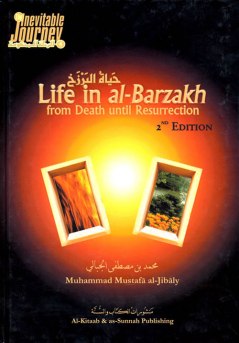
Life in al-Barzakh
The Inevitable Journey Series (Part-4) by Muhammad al-Jibaly
Publisher: Al-Kitaab & as-Sunnah Publishing
About the Book: The Inevitable Journey, We inevitably go through the journey starting in this life and extending into the grave, before our final abode in the hereafter. In the process, we pass through stages of sickness, death, and the intermediate life in the grave (al-Barzakh). These are the subjects that “The Inevitable Journey” discusses over a sequence of tides:
1. Sickness, Regulations & Exhortations
2. The Final Bequest, Islamic Inheritance and Will
3. Funerals, Regulations & Exhortations
4. Life in al-Barzakh
5. Dreamer’s Handbook
This book is the fourth in the series. It deals with many important matters that have always perplexed the human minds, but that, as is shown in this book, have been clearly explained in the authentic Texts from Allah’s Book and His Messenger’s Sunnah. Among the subjects covered are the following: *The Moment of Death *The Soul’s Trip to the Heavens*The Final Test*The Righteous and the Sinful in al-Barzakh*Saviors from the Grave’s Punishment*Communications with al-Barzakh*Things That Benefit the Dead.
 AsbaulHadeeth.com