
Download
(Right click then save target as)
The Ruling on Christmas & New Year
Shaykhul-Islaam Ibn Taymiyyah
Muhammad bin Saleh al-Uthaymeen
Download
(Right click then save target as)
The Ruling on Christmas & New Year
Shaykhul-Islaam Ibn Taymiyyah
Muhammad bin Saleh al-Uthaymeen
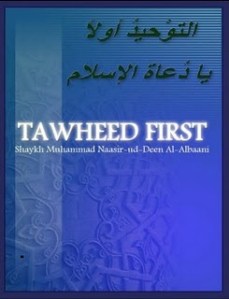
Download
(Right click then save target as)
Shaykh Naasir ud Deen al Albaanee
This book is based on one of the Fataawaa of the hadeeth scholar of the era, Muhammad Naasiruddeen al-Albaanee may Allaah have mercy on him, an Excellent work concerning the importance of giving priority to Tawheed
Quite a number of Muslims today, especially those living in Christian dominated countries or those influenced to a large degree by western culture, have been led to consider that taking part in the Christmas celebrations of friends and relatives is, at very least, a harmless pastime if not a legitimate source of pleasure for children and adults alike. In many instances, pressure to conform with the practices of society is too great for those of weak resolve to withstand. Parents are often tempted to give in to the pleading of children who have been invited to a party or who are unable to understand why they alone are being prevented from joining the festivities they observe all around them or why they cannot receive gifts on this occasion like the other children.
Indeed, the Christmas season has been aggressively promoted in every aspect of business, in schools, in every public place. High pressure sales tactics have invaded the home through television, radio, magazine and newspaper, captivating the imagination with every
kind of attraction day and night for a month or more every year. Little wonder that many of those thus targeted so persistently succumb to temptation. Among earlier generations, Christmas was an occasion which was still basically religious in orientation. Gifts, trees,
decorations and feasting assumed lesser roles. But now all of this has changed. As noted in an American publication, Christmas has gone the way of many other aspects of society, becoming one more element in the mass culture which every season enables manufacturers
and merchants to make millions of dollars through an elaborate system of gift exchange which comes more often from mutual expectations that “must” be fulfilled than from the heart. The commonly accepted notion that happiness is derived largely from possessions and
entertainment is the driving force behind the month-long preparations and festivities which continue on through the end of the year. This fact, although blameworthy in itself, has led many Muslims into the delusion that Christmas is no longer a religious occasion and therefore
does not conflict with Islamic belief.
The materialistic atmosphere surrounding the celebration of Christmas is, in reality, a manifestation of pagan culture (Jaahiliyyah) at its worst. It can only be seen by the conscious Muslim believer as a rat-race designed and implemented by Shaytaan to accomplish a great
waste of time, effort, money and resources while countless families barely subsist in a state of poverty throughout many areas of the world. In addition to the commercial side of Christmas, although less obvious to the casual observer, are certain religious aspects to be
noted. The celebration was and still is intended by practising Christians as a remembrance of the birth of Jesus Christ (peace be upon him) who is considered by many of them as God incarnate or the second person in a trinity, and thus they celebrate the birth of “divinity.” The
word itself is an abbreviated form of “Christ Mass,” i.e., sacrament in commemoration of Christ. Although taken by Christians to be the birthday of Jesus, the actual date of celebration, December 25th, cannot be traced back any further than the fourth century after
Christ. Ironically, this day is also considered to be the birthday of the Hindu god, Krishna, as well as Mithra, the Greek god of light. It also coincides with the annual Tree Festival which had long been celebrated in Northern Europe before the Christian era and which has been recently revived in some Arab countries in an attempt to encourage celebration by disguising the religious significance of the day.
The Christmas tree is the most obvious aspect of that pagan celebration which was incorporated along with its date of observance, December 25th, into church rites. The evergreen tree, because it keeps its green needles throughout the winter months, was
believed by pre-Christian pagans to have special powers of protection against the forces of nature and evil spirits. The end of December marked the onset of a visible lengthening of daylight hours – the return of warmth and light and defeat of those evil forces of cold and
darkness. At a particular stage of its development, the church is known to have adopted certain of the popular pagan practices into Christianity for political or social reasons.
Thus, in more aspects than one, the holiday is deeply rooted in the worship of different forms of creation rather than the Creator Himself. A Muslim cannot possibly approve of such beliefs or the practices which stem from them. Anyone with a minimal knowledge of Islam
would surely reject kufr (disbelief) and shirk (association of partners with Allaah) in every form. Only through ignorance or unawareness could one continue to participate in activities that reflect the acceptance of both. Muslims must be firm in refusal of all which is contrary to the concept of “Laa ilaaha illallaaha (there is none deserving of subservience except Allaah alone).” Consideration for others is well and good on the condition that Islamic principles are
not compromised.
Allah (subhaanahu wa ta’aalaa) says:
{If you obey most of those upon the earth, they will lead you away from the way of Allaah} [An’aam 6:116]
And He commands:
{Follow what has been revealed to you from your Lord and do not
follow any patrons other than Him} [A’raaf 7:3]
Although some, in all honesty, admit their weakness in the face of continual social pressure, others defend their participation by the strange assertion that they observe the occasion through regard for Jesus (‘Isa), a prophet of Islam. If such an observance, with its
semblance of Islamic atmosphere, is invalid for Prophet Muhammad (صلى الله عليه وسلم), how then can it reasonably be valid for other prophets who neither observed nor encouraged such practices, which were later devised by those who abandoned prophetic teachings for their own
inclinations and preferences?
{Have you seen him who take as his god his own desire, and Allah has left him astray through knowledge} [Jaathiyah 45:23]
Again, the Muslim is reminded of the hadiths in which the Prophet (صلى الله عليه وسلم) warned against imitating the non-believers and encouraged distinguishing oneself from them in dress and manner. Whether taken from the materialistic or the religious standpoint, Christmas can
have no place in the Muslim’s heart nor in his home. Any Muslim, young or old, who has a secure place in an Islamic community or group which has regular activities and affords
companionship will find little difficulty in rejecting that which is harmful to himself and his family, in spite of the apparent attractions. In some societies, refusal and resistance may require actual jihad, but those who seek the acceptance of Allah and fear Him will undertake
the task with knowledge that they are striving for salvation and will thus be firm and resolute. For Allah (subhaanahu wa ta’aalaa) calls to believers, saying:
{O you who have believed, protect yourselves and your families from a Fire whose fuel is men and stones} [Tahreem 66:6]
And in the avoidance of Hellfire lies Paradise.
IslamHouse.com

Download
(Right click then save target as)
Allah (SWT) honored them by allowing them to ac-company His Prophet (saw). He favored them in this worldly life by giving them the opportunity to see him and hear his hadîth directly from his noble mouth….This is the bounty of Allâh which He bestows upon whom He wills, and Allah possesses the Greatest of bounties.
Indeed the Companions conveyed from Allâh’s Messenger (saw) that which he was sent with from guidance in the most complete and perfect form. They will have the greatest of rewards due to their companionship of Allâh’s Messenger (saw), their fighting in Jihâd along his side, and their noble actions in spreading Islam.’
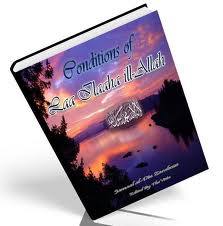
Download
(Right click then save target as)
Jamaal Zarabozo
The Conditions of the Testimony of Faith ‘Laa Ilaaha ill-Allah’ – There is no diety worthy of worship except Allaah.
“So know that Laa ilaaha ill-Allaah” [47:19]
http://www.islamicknowledge.co.uk
Shaykh Muhammad bin Saalih al-Uthaymeen in Sharh Lam’ah al-I’tiqaad
Praise be to Allaah.
Aqeedah refers to those matters which are believed in, with certainty and conviction, in one’s heart and soul. They are not tainted with any doubt or uncertainty. The Arabic word ‘aqeedah stems from the root ‘aqada, which conveys meanings of certainty, affirmation, confirmation, etc. In the Qur’aan, Allaah says (interpretation of the meaning):
“Allaah will not punish you for what is unintentional in your oaths, but He will punish you for your deliberate oaths (bimaa ‘aqqadtum al-aymaan)…”
[al-Maa’idah 5:87]
The verb paraphrased here as “deliberate oaths” is ‘aqqada/ta’qeed, which refers to when one has determination in the heart. It may be said in Arabic, ‘aqada’l-habl (the rope was tied), i.e., it was pulled tight together. The word i’tiqaad (belief) is also derived from this root,
and has the meaning of tying up and making strong. The phrase a’taqadtu kadhaa (I believe such and such) means: I am convinced of it in my heart; this is a rational conviction.
In Islam, ‘aqeedah is the matter of knowledge. The Muslim must believe in his heart and have faith and conviction, with no doubts or misgivings, because Allaah has told him about ‘aqeedah in His Book and via His Revelations to His Messenger sal’lal’laahu alaihi wa sallam.
The principles of ‘aqeedah are those which Allaah has commanded us to believe in, as mentioned in the aayah (interpretation of the meaning):
“The Messenger believes in what has been sent down to him from his Lord, and (so do) the believers. Each one believes in Allaah, His Angels, His Books and His Messengers. They say, ‘We make no distinction between one and another of His Messengers’ – and they say, ‘We hear, and we obey. (We seek) Your forgiveness, our Lord, and to You is the return (of all).’” [al-Baqarah 2:285]
– and as defined by the Prophet sal’lal’laahu alaihi wa sallam in the famous hadeeth which describes how Jibreel came to him and asked him about Islam etc.: “Eemaan (faith) is to believe in Allaah, His angels, His Books, the meeting with Him on the Last Day, His Messengers, and the Day of Resurrection.” So in Islam, ‘aqeedah refers to the matters which are known from the Qur’aan and sound ahaadeeth, and which the Muslim must believe in his heart, in acknowledgement of the truth of Allaah and His Messenger.
This article can be downloaded on pdf format Clink Here

Tape 01 | Tape 02 | Tape 03 |
(Right click then save target as)
CD 1: Companions the ultimate generation
CD 2: Abu Bakr & Umar
CD 3: Uthman & Ali
Allaah chose Muhammad (صلى الله عليه وسلم) above all creation to convey His message, and He chose the people who were around His messenger to defend and spread the Deen, The companions were described by the Prophet as being the best of generations, thus it is a must for every Muslim to follow and emulate their ways. Abu Hasnayn explains the importance and virtues of the companions of the Prophet. These series of Khutbas (sermons) provide the listener with a great introduction to the lives of the four rightly guided khulafa: Abu Bakr, Umar, Uthman and Ali, may Allah be pleased with them all. The lectures give an insight into the lives of these great men who led the Muslims of their time to victory by Allah’s permission. What lessons can we derive from their lives? Listen and be amazed by their simplicity, sincerity and service to Islam.

Track 1 | Track 2 | Track 3 | Track 4
(Right click then save target as)
The Life of The Imaam of The People of Sunnah Abu Abdillaah Ahmad Ibn Muhammad Ibn Hanbal al-Shaybani Rahimaullaah.
by Kamal el-Mekki
all four parts can be also watched on youTube Click Here
![Biographies Of The Rightly-Guided Caliphs [Sirat-Ul Khulafa]](https://ashabulhadeeth.com/wp-content/uploads/2010/12/caliphs.gif?w=300)
Download
(Right click then save target as)
by Ibn Katheer, At-Tabari, As-Suyooti and Other Historians.
The four Rightly guided Caliphs (Khaliph’s) Abu Bakr As-Sideeq, Umar ibn Al-Khattaab, Uthmaan Ibn ‘Affaan and Ali Ibn Abi Taalib. The Biography of Umar Ibn Abdel-Azeez who is regarded as one of the Rightly Guided Chaliphs is also included in this book.
alGhurabaa.org
 AsbaulHadeeth.com