Caged Lions and Our Responsibility

In the wake of the attacks on New York and the Pentagon in September 2001, the Republican Administration of George Bush, capitalising on the climate of fear and chaos, introduced a raft of repressive new security measures that undermine civil liberties. The PATRIOT Act 2001 enables the US Government to arrest and detain people in conditions of secrecy for indefinite periods if there are ‘reasonable grounds’ that may constitute a threat to national security. As an aftermath of the ‘war on terror’ many injustices are befalling the Muslim Ummah, and the battle between Truth and Falsehood has transpired, as the world continues to witness the oppression of Muslims whom are stripped of their dignity, their honour, and their freedom of faith.

Throughout history the oppressors have used incarceration as a means to silence the voice of Truth. As Ibn Taymiyyah is known to have stated, “What can my enemies do to me? My paradise and garden are in my chest, and do not leave me. My imprisonment is seclusion with Allāh, and my death is martyrdom, and my expulsion is tourism. If the people who imprisoned me were given the equivalent of this prison in gold, it would not do them as much good as what Allāh has given me with this prison.”

One of the most influential of Muslim writers of recent times, Sayyid Qutb, was executed, and before his execution, he would repeat his famous statement: “Verily, the index finger that testifies to Allāh’s Oneness in the prayer rejects that it be used to write a single letter acknowledging the rule of a tyrant.” (‘Sayyid Qutb: Min al-Milād ilā al-Istishhād’ (p. 61-62, 462, 474, and 481))

The horrendous gulags set up world wide, in order to torture the believers, in an attempt to eradicate the ‘terror’ threat. The current day tyranny dehumanises the oppressed, and terrorises the innocent. If one was to know the duties of the Ummah over the Muslim Captives, then by Allaah, there would not be one single unjust imprisonment of a Muslim anywhere in the world. If one was to know the real meaning of the concept of ‘brotherhood’ in Islam, then by Allaah, the Ummah of Muhammed would not be in the state it is today.

Ibn Abbas reported that Umar (May Allaah pleased be with him) said, “Every Captive who is in the hands of the disbelievers, then the ransom to free him will be paid from the treasury of the Muslims (Narrated by Ibn Abi Shaybah in his ‘Musannaf’; 6/497)

Ibn Abi Shaybah also reported that Umar narrated, “For me to rescue a Muslim from the lands of the disbelievers is more beloved to me than the entire Arabian peninsula.” (Musannaf; 6/496)

Islam has demanded the freeing of the Muslim Captives from the hands of the enemies. It is from the Islamic rights and obligations which must be fulfilled in regard to Muslim Prisoners. Therefore if a Muslim falls into the prisons of the enemies then it becomes incumbent upon the Muslims to do all they can within their capacity to free the Muslim Captives, as the Prophet Muhammed (peace be upon him) has stated, “free the prisoner, feed the hungry, visit the sick.” (Narrated by Bukhari).

The significance of the Muslim Prisoners is apparent, thus it is our duty to do as much as we can in order to assist them. One can be alone, but not lonely, thereby offering letters of support and keeping in constant communication with the prisoners, allows them to be empowered, and hold onto their sanity. It gives them hope and strengthens their faith. This is the least an individual can do. To ignore the plight of the prisoners is an abhorrent offence. To turn a blind eye whilst our brothers and sisters are kept alone in a cell is in direct violation of Tawheed.

“But, if you remain patient and become pious, not the least harm will their

cunning do to you. Surely, Allāh surrounds all that they do.” (Āl ‘Imrān; 120)

Muslims fear no one but Allaah. Many people neglect the Muslim prisoners because they are either too frightened of the authorities or they are too lazy to act. Such people need to reaffirm their emaan, and study the deen inherently closely. It is the responsibility and duty of every Muslim to defend his brother and sister in Islam. So what of the Muslim Captives? Our incarcerated Muslim brothers and sisters who spend years confined within the same four walls. The obligation of brotherhood in the Qur’an and Sunnah is unmistakably clear. We must be extremely cautious in correctly upholding this concept to prevent transforming this sacred relationship into a superficial bond, thus lacking the true essence of Islamic brotherhood.

The Prophet صلى الله عليه وسلم said: “You will not enter paradise until you believe, and you will not believe until you love one another. Shall I not guide you to something which if you carry out you will love one another? Spread salaam amongst yourselves.” [Muslim]

It is necessary to let the Muslim prisoners know that we care for their well-being, that we sincerely love them as we do our own blood brothers, and that we are ready to help them in any way we are able to.

“And they plotted, and Allāh plotted, and Allāh is the best of plotters.” (Āl ‘Imrān; 53)

Surely, victory is with the believers. It has been narrated by Al-Bukhari in Al-Adaabul-Mufrad that the Prophet صلى الله عليه وسلم said: “If one of you loves his brother for Allah’s sake, then let him know, since it causes familiarity to endure and firmly establishes love.”

Preserving our Muslim character is both an obligation and a challenge at the same time. It is paramount for Muslims everywhere to remain attentive of the notion of brotherhood as a most critical tool in striving to keep their distinct identity. Therefore, it is an obligation to follow the lead of the Prophet صلى الله عليه وسلم and his Companions in this manner and do whatever is required to maintain it.

“Surely, Allāh wrongs not even of the weight of an atom. But, if there is any

good done, He doubles it, and gives from Him a great reward.” (an-Nisā’; 40)

“O you who have believed, when you encounter a company [from the enemy forces] stand firm and remember Allah much that you may be successful.” (Al Anfaal 45)

Verily the reward of the Muslim Captive lies only with Allaah.


Virtues of Various Chapters of the Qur’an

Here are some ahadith regarding the virtues of various chapters of the Qur’an, collected from some of the books of Shaykh al-Albani (may Allah have Mercy upon him):

1 – ‘al-Fatihah’:

Ibn ‘Abbas narrated:

“While Jibril was with the Messenger of Allah, he heard a noise from above. Jibril lifted his sight to the sky and said: “This is a door in the Heavens being opened, and it has never been opened before now.” An Angel descended from that door and came to the Prophet and said: “Receive the glad tidings of two lights that you have been given, which no other Prophet before you was given: the Opening of the Book, and the last verses of ‘al-Baqarah.’ You will not read a letter of them except that you will gain its benefit.””

[‘Sahih at-Targhib wat-Tarhib’; # 1456]

2 – ‘al-Baqarah’:

“Whoever recites Ayat al-Kursi (verse # 255) after every obligatory prayer, then there is nothing between him and his entrance into Paradise except his death.”

[‘Sahih al-Jami”; # 6464]

“Verily, Allah Wrote a Book one thousand years before He Created the Heavens and the Earth; from this Book descended the last two verses of ‘al-Baqarah.’ These verses are not recited for three nights in any home except that no devil can come near it.”

[‘Sahih al-Jami”; # 1799]

3 – ‘az-Zumar’ and ‘al-Isra”:

‘A’ishah said:

“The Prophet would never sleep until he had recited ‘az-Zumar’ and ‘Bani Isra’il’ (i.e., ‘al-Isra”).”

[‘as-Silsilah as-Sahihah’; # 641]

4 – The Glorifiers:

al-’Irbad bin Sariyah said:

“The Prophet would not sleep until he had recited ‘al-Musabbahat’ * (the Glorifiers), and he would say: “In them is a verse that is better than a thousand verses.”

[‘Sahih at-Tirmidhi’; # 2712]

*: ‘al-Musabbahat’ are those chapters that begin with “سبح” or “يسبح” and they are: ‘al-Isra’,’ ‘al-Hadid,’ ‘al-Hashr,’ ‘as-Saff,’ ‘al-Jumu’ah,’ ‘at-Taghabun,’ and ‘al-A’la.’

5 – ‘al-Kahf’:

“Whoever memorizes the first ten verses of ‘al-Kahf,’ then he will be protected from the trial of the Dajjal.”

[‘as-Silsilah as-Sahihah’; # 582]

“Whoever recites ‘al-Kahf’ as it was revealed, he will have a light on the Day of Resurrection that will reach from wherever he is all the way to Makkah. And whoever recites the last ten verses of it, and the Dajjal emerges right after, then he will not be harmed by him. And nobody makes ablution, then says: ‘Glory and praise be to You, O Allah. I bear witness that there is none worthy of worship but You. I seek Your forgiveness and turn to You in repentance’ [Subhanak Allahumma wa bi Hamdik; ashhadu an la ilaha illa Ant. Astaghfiruk wa atubu ilayk] except that it is written on a tablet and permanently transcribed on that tablet, and that tablet will not be broken or damaged until the Day of Resurrection.”

[‘as-Silsilah as-Sahihah’; # 2651]

“Whoever recites ‘al-Kahf’ on the night before Friday, then a light will be lit for him between wherever he is and the Ka’bah.”

[‘Sahih at-Targhib wat-Tarhib’; # 736]

6 – ‘al-Mulk’:

“There is a chapter in the Qur’an that is made up of thirty verses. It interceded for a man until he was forgiven all of his sins, and that chapter is ‘Tabarak.’

[‘Sahih at-Tirmidhi’; # 2315]

7 – ‘al-Ikhlas’:

“Whoever recites ‘Qul Huwa Allahu Ahad’ and completes it ten times, Allah will build a palace for him in Paradise.”

[‘as-Silsilah as-Sahihah’; # 589]

The Manners Of The Knowledge Seeker

The Manners Of The Knowledge Seeker


Download

(Right click then save target as)

by Muhammad Sa’eed Raslan
The Islamic knowledge is the legacy of a prophet, the scholars are heirs of the prophets, and this is why the Knowledge seekers were among the best people.

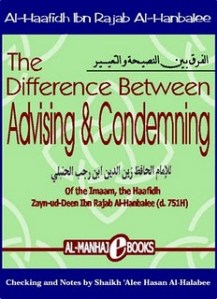
The Difference between Advising and Condemning

The Difference between Advising and Condemning

The Difference between Advising and Condemning by Ibn Rajab al-Hanbali


Download

(Right click then save target as)

In this classical treatise, Ibn Rajab (may Allah have mercy on him) discusses the differences between advising and condemning, which is an extremely important topic since it is very common that the two are confused for one another. For the most part, his talk revolves around the dealings and affairs of the scholars, and how it was from their way to advise and accept the truth from one another. And he shows how condemning was not from their characteristics, but rather from the signs of the evil and wicked people who held hidden goals and objectives.This book is especially important in these days due to the wide scale confusion that exists on this subject amongst the Muslims. So today when we find scholars of the Sunnah refuting weak opinions of other scholars from the past, they are quickly accused of hating those scholars of the past and just condemning them, when in fact they are really advising the ummah and warning the Muslims against following a man in his error. So, we hope that these matters become clear to the reader upon studying this treatise and that he is able to distinguish those who are truly advising from those who are just condemning.

Question: To what degree is a Muslim to be concerned with politics today, within it’s Islaamic guidelines?

Question: To what degree is a Muslim to be concerned with politics today, within it’s Islaamic guidelines?

Answer: If what is intended by “politics” is the administering of the ummah, then the reality is that politics is not from the acts of one individual from the people of the ummah, but rather, it is from the duties of the Muslim State. This is if the objective behind politics, as we stated before, is the administering of the ummah and the managing of its concerns in order to rectify what is in it from its
religious and worldly affairs. So if this is what is intended by “politics”, then this is fard kifaayah (a collective obligation). However, it is not for those people who are not in control of the state or of the rule, nor for those who can neither produce benefit nor cause harm.

As for obtaining the news to be aware of the state of affairs and the weakness the Muslims are in, and in order to avoid this outcome, then as we say, this is from the tasfiyah (purification) and the tarbiyah
(educating) – purifying Islaam from what has entered into it and focusing on educating the Muslims and bringing them up on this purified Islam. So knowing these general circumstances, which encompass the Muslims, is a must for the matter is as the old Arab poet has stated, taking his meaning
from an authentic hadeeth:

“I learned evil not for the sake of evil, but to avoid it
And whoever doesn’t know good from evil, he will fall into it.”

This is derived from a hadeeth – and I mean by it, the hadeeth of Hudhaifah Ibn Al-Yamaan, radyAllaahu ‘anhumaa, which is reported in the Saheehs of Al-Bukhaaree and Muslim. He, radyAllaahu ‘anhumaa, said: “The people used to ask Allaah’s Messenger صلى الله عليه وسلم, about the good, but I used to ask him about the evil for fear of it reaching me.” So being aware of what the Muslims are upon from humiliation and weakness in order to turn them away from that towards using the means of knowledge, strength and power, this is an obligation from the many obligations.

As for engaging at length in obtaining news, knowledge of battles and western politics, then this is from the aspect of: “Knowledge of something is better than being ignorant of it.” This is something
that we do not forsake. However, at the same time, we must not be very enthusiastic and fanatica about it. This is since the Prophet صلى الله عليه وسلم did not establish the affair of his Companions on knowing and following precisely, the news of his enemies to the same extent as he صلى الله عليه وسلم used to focus on teaching his Companions from one perspective and cultivating them on Allaah’s command from another perspective. This is our belief concerning politics based on their two categories, which we have mentioned previously.

[Al-Asaalah, Issue #18]

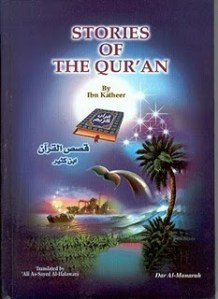
Stories Of The Qur’an

Stories Of The Qur’an

Stories Of The Qur’an by ibn kathir


Download
(Right click then save target as)

Here we are with the book Stories of the Qur’an by AI-Hafiz Isma` il Ibn Katheer Ad- Dimashqi (May Allah rest his soul), taking a tour throughout the stories mentioned in the Glorious Qur’ an pertaining to which Allah the Almighty says: {Indeed in their stories, there is a lesson for men of understanding}. (Yusuf, 111) Yes, in order to find admonition, lessons and exemplary models! This book handles the stories that are cited in the Glorious Qur’an, gathered from the book titled, Al-Bidayah wan-Nihayah (The Beginning and the End).

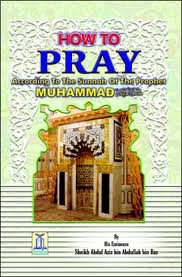
The Description Of The Prophet (صلى الله عليه وسلم) Prayer

The Description Of The Prophet’s Prayer - Abdul-Azeez bin Abdullah bin Baaz

Download
(Right click then save target as)

The Description Of The Prophet’s Prayer
Abdul-Azeez bin Abdullah bin Baaz

This is a brief booklet which describes the Prophet (صلى الله عليه وسلم) prayer and is presented to all Muslims so that they may strive hard to imitate him when performing their Prayers, for he (صلى الله عليه وسلم) said: “Perform your Prayers as you have seen me performing them” (Reported by Sahih Al Bukhari)

The Explanation of The Beautiful and Perfect Names of Allah

The Explanation of The Beautiful and Perfect Names of Allah

The Explanation of The Beautiful and Perfect Names of Allah by Shaykh Abdur-Rahman bin Naasir al-Sa'di


Download

(Right click then save target as)

Shaykh Abdur-Rahman bin Naasir al-Sa’di
A brief explanation of some of the Names of Allah

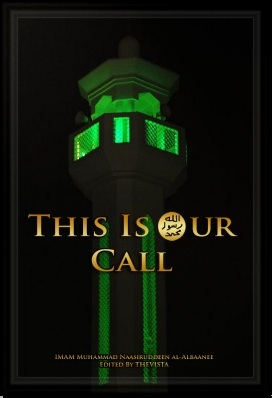
This Is Our Call (The Way Of The Salaf)

This Is Our Call (The Way Of The Salaf)

This Is Our Call (The Way Of The Salaf) Sheikh Naasir-ud-Deen al Albani


Download

(Right click then save target as)

This is a translated transcription of a lecture delivered by Imaam Al- Albaanee (rahimahullaah) that was recorded and distributed under the title “Hadhihi Da’watunaa” (This is Our Call). The present translation was translated directly from the Arabic audio. In this lecture, Imaam Al-Albaanee explains the basis of the Salafee Manhaj, which is following the way, understanding and practical application of the Salaf, who were namely the first three generations of Muslims: The Sahaabah, Taabi’een and Atbaa’ at-Taabi’een. They are the ones referred to in the Prophet’s saying: “The best of mankind is my generation, then those that come after them, then those that come after them.” This is the basis that distinguishes the true call to Islaam from all other false and erroneous calls, regardless if they claim to be “upon the Qur’aan and the Sunnah.” Al- Albaanee goes into depth discussing this fact, that one cannot truly understand and apply the Qur’aan and Sunnah unless he follows the understanding and application of the Salaf. We ask Allaah to accept this effort and benefit the Muslims with it.