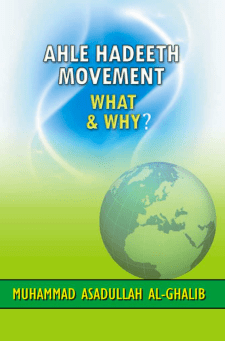
The Ahle Hadeeth Movement, What & Why?

Ahle hadith ahl al-hadith movement English translation of the bangla book Ahle hadees Andolon


Download

(Right click then save target as)

by Dr. Muhammad Asadullah Al-Ghalib, Professor of Arabic, University of Rajshahi, Bangladesh.
Translated by Sohrabuddin Ahmad, Assoc. Prof. (Rtd) Dept. of Islamic History & Culture.
Published by: HADEETH FOUNDATION BANGLADESH

Ahle hadeeth movement is the oldest and unadulterated movement among all Islamic movements of the world. To bring the people of the world under the essence of the holy Quran and Saheeh Hadeeth, the puritan movement which has been continued from the age of the honoured Sahabis is called Ahle hadeeth movement. The aim of this movement is to gain the satisfaction of almighty Allah. It’s foundation is only the holy Quran and saheeh Sunnah. Since the 1st publication in July 1979, this book has been rendering a very important role in promoting Ahle hadeeth movement in Bangladesh. The honourable Author has put tremendous effort to do an almost impossible task of consisting a difficult and vast subject in this short book and to hand it over towards the people in lucid and simple language

Conditions of Laa ilaaha ill-Allaah

Firstly: Knowledge (al-’ilm) of its meaning, what it negates and affirms. If a person says it without knowing its meaning, nor what its requirements are, then he will not benefit by it, because he has not believed in what it requires. Rather, he is like someone who speaks in a language that he does not understand.

Secondly: Certainty (al-yaqeen), which is [to have] complete surety of it and which leads to repelling any doubt or suspicion about it.

Thirdly: Exclusively worshipping Allaah (al-ikhlaas), which is contrary to shirk. This is what laa ilaaha illallaah points towards.

Fourthly: Truthfulness (as-sidq), which prevents hypocrisy (nifaaq). Indeed, the hypocrites uttered it with their tongues, but did not inwardly believe in what it signified.

Fifthly: Love (al-mahabbah) for this kalimah and having love and pleasure for whatever it necessitates. This is contrary to the [state of the] hypocrites.

Sixthly: Submissive compliance (al-inqiyaad), by fulfilling its rights – which are the obligatory actions – with sincerity to Allaah and seeking His good pleasure. This is its requirement.

Seventhly: Acceptance (al-qabool), which prevents rejection. This is achieved by acting upon what Allaah has commanded and abandoning whatever He has prohibited.

Scholars have deduced these conditions from those texts of the Book and the Sunnah which are pertinent to [understanding] this great kalimah; and which explain its rights and restrictions and that it is not merely a word that a person utters.

Some scholars, such as Shaykh ‘Abdul-’Azeez bin Baaz in Majmoo’ Fataawaa wa Maqaalaat Mutanawwi’ah (7/56) and Shaykh ‘Abdullaah ibn Jibreen in ash-Shahaadataan (p.77), add an eighth condition: The rejection of whatever else is worshiped besides Allaah.

taken from the book The Declaration of Faith by shaykh Saalih al-fawzaan translated by Abu Aaliyah

The Declaration of Faith

The Declaration of Faith by shaykh saleh al-fawzaan


Download

(Right click then save target as)

The testimony of “Laa ilaaha ill-Allah”, its meaning, prerequisites, conditions, and fruits.

Belief In The Angels

Faith in the Angels

Sheikh Salih bin Abdullah bin Fauzaan al-Fauzan


Download

(Right click then save target as)

This booklet comprehensively covers all four aspects of Belief in Angels; belief in their existence, functions, names and attributes. Additionally, important points of Tawheed are highlighted by refuting incorrect understandings, for example the false claims of contemporary grave-worshippers that are similar to those made by the pagan Quraish during the time of Allah’s Messenger.

In the course of the booklet, clarification of a number of doubts have also been included such as explaining Qur’aanic verses like, “We are nearer to him than his jugular vein…” This refers to the Angels of Allah and does not indicate that Allah is present amongst His creation.

The booklet also compares the likeness in the thinking of those who claim that Prophet (sallallahu alaihi wa-sallam) was created from Nur (i.e., light, which is a characteristic of the Angels) and the mentality of the disbelievers who demanded that an Angel be sent as a Messenger.

The latter section of the booklet enumerates characteristics of those fortunate people, on behalf of whom the Angels seek forgiveness and supplicate for their well-being in this world and the Hereafter. It also lists those unfortunate people, against whom the Angels invoke Allah.

This part of the book is mainly based upon the book, ‘Fariston ka Darood panewale aur Lanat panewale’ (Urdu) by Dr. Fazl-e-Ilahi.

Numerous other original Arabic books were referred to in the compilation of this booklet, mainly; al-Eeman bil-Malaaikah wa-Athruhu fi-Hayatil-Ummah by Shaikh Salih Ibn Fawzan al-Fawzan, Aalam al-Malaai’kah al-Abrar and ar-Rusul war-Risalaat by Shaikh Umar al-Ashqar, beneficial lectures of Shaikh (Dr.) Abdullah al-Farsi, Tafseer Ibn Katheer, Riyadus-Saliheen and others.

May Allah make us amongst those who deserve the Salaat of His Angels. All strength and success lies with Him Alone.

Shawana A. Aziz
http://www.QSEP.com


Belief in the Angels

Belief in the Angels by shaykh saalih al-fawzaan


Download

(Right click then save target as)

This is a complete translation of a short treatise called, ‘al-Eemaan bil-Malaa’ikah wa Atharuhu fee Hayaat-il-Ummah’ Although this treatise is short in size, it provides many proofs and evidences for the descriptions, duties and general characterisitics of the angels.

Usool as-Sunnah / أصول السنة

Usul us-Sunnah English / أصول السنة عربي


Download

(Right click then save target as)

Imaam Ahl al-Sunnah Abu Abdillah Ahmad ibn Muhammad ibn Hanbal Rahimaullaah

Edited By Aboo Ibrahim

Shaykh Abu ‟AbdullâhYahyâ ibn Abil-Hasan ibn al-Banna narrated to us saying: My father Abuu ‟Ali al-Hasan ibn ‟Umar ibn al-Bannaa related to us, saying: Abul- Hussain ‟Ali ibn Muhammad ibn ‟Abdullaah ibn Bushrân al-Mu‟addil relatcd to us, saying: ‟Uthmaan ibn Ahmad ibn as-Sammak reported to us, saying: Abu Muhammad al-Husan ibn ‟Abdul-Wahhaab, Abun-Nabr narrated to us, reading it to him from his written copy in the month of Rabi’ul-Awwal, in the year two hundred and ninety-three (293H), who said: Abu Ja‟far Muhammad ibn Sulaiman al-Munqarî, in Basrah, related to us, saying: ‟Abdus ibn Malik al-‟Attar narrated to me, saying: I heard Abu ‟Abdullah Ahmad ibn Hanbal – radiallahu ’anhu – say:

The Fundamental Principles of the Sunnah with us are:

Holding fast to what the Sahaabah (Companions) of the Messenger of Allah were upon.

Taking them [and their way] as a model to be followed.

The abandonment of al-Bid’ah (innovations),

and every Bid’ah is misguidance.
…..

www.IslamicKnowledge.co.uk


A Gift to the Barailwis

A gift to Barelvi's Ali Hasan Khan Ahle hadith Pakistan


Download

(Right click then save target as)

Umm-ul-Qura Publications has prepared a Booklet, entitled “A Gift for the Brawliyah”. We have Al Hamdulilah published 3000 copies for free distribution in the UK and we hope to publish more. www.umm-ul-qura.org

Section on Raising The Hands In The Prayer

Section on Raising The Hands In The Prayer

Juz Raf al-Yadayn in Salaah


Download

(Right click then save target as)

Juzz Rafa al-Yadain fi as-Salah
(Section on Raising the Hands in the Prayer)

Author: Ameerul Mu’mineen in Hadith, Imam
Muhammad bin Isma’eel al-Bukhari rahimahullaah

Tahqeeq and Takhreej done by Shaikh Zubair Ali Zai
Translated by Raza Hassan

Etiquette of Seeking Knowledge [PDF Book & Explanation on MP3 Files]

Etiquette of the knowledge seeker by Sheikh Bakr Abu Zayd


Download

(Right click then save target/link as)

————————————————


{MP3 Part 1} | {MP3 Part 2}

(Right click then save target/link as)
Brief Explanation of Etiquette of Seeking Knowledge by Ahsan Hanif (Audio)

By: Shaykh Bakr Aboo Zayd
Translator: Abu Abdillah Murad
Publisher: Al-Hidaayah

The Etiquette of Seeking Knowledge … to adorn oneself with beautiful etiquette, noble manners, good behaviour, and pious conduct are distinguishing characteristics of the people of Islaam, and knowledge – the most precious pearl in the crown of the purified Shareeah – cannot be attained except by those who adorn themselves with its etiquette and those who leave evil qualities associated to it. For this reason the scholars devoted their attention to this etiquette, outlined its importance and wrote books solely on this topic; either pertaining to (general conduct] with all types of knowledge or to specific types of knowledge such as the etiquette of the carriers of the Noble Quireaan, the etiquette of the muhaddith, the etiquette of the muftee, the etiquette of the qaadee (judge), the etiquette of the muhtasib (the one who enjoins good and forbids evil for the sake of Allaah) and so on. The issue of this book is the general conduct of those who take the path of seeking the knowledge of the Sharee’ah.

al-Ajurumiyyah

al-Ajurumiyyah Poem Text & Audio

al-Ajurumiyyah Poem Text & Audio

Download
(Right click then save target as)

{Download Audio}
(Right click then save target as)

al-Ajurumiyyah Poem in PDF format & Audio to help in memorisation


al-Ajurumiyyah Text & Audio

al-Ajurumiyyah Text & Audio


Download

(Right click then save target as)

{Download Audio}
(Right click then save target as)

al-Ajurumiyyah on PDF format with Audio


Links

al-Ajrumiyyah 2010 – Muhammad al-Malki
al-Ajurrumiyyah Forum
al-Aajurroomiyyah Blog